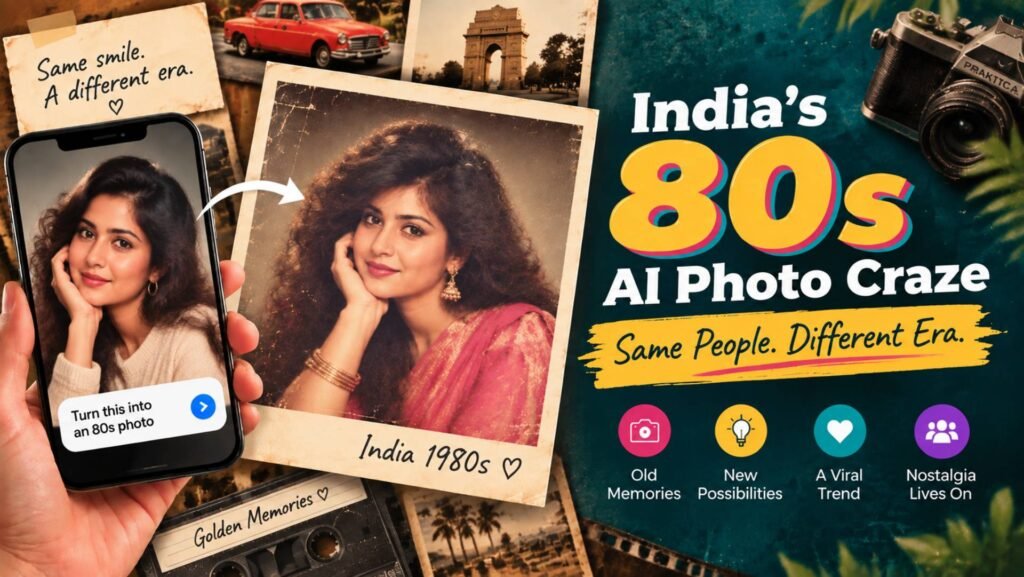
If your social media feed suddenly looks like a family album from 1987, you are not alone. AI-generated portraits featuring feathered hair, flared trousers, silk sarees, leather jackets, warm film grain and dramatic studio lighting have spread rapidly across Instagram, X and other platforms.
India has been at the centre of this visual wave. Actors, television personalities, politicians, cricketers and everyday users have shared their own versions. The scale of Indian participation has even led some people to ask whether the viral 1980s AI photo trend started in India.
The short answer is that there is no reliable evidence proving it did.
No verified first post, original prompt or confirmed Indian creator has been identified. Retro AI portraits appeared in different forms across the internet, and trends like this rarely follow a single, traceable route. Available reporting does show that India became one of the trend’s most active and recognisable centres.
This Retro AI Photo Craze shows how global AI trends can take on new meanings when communities add their own cultural references, fashion, and memories.
What Is the Viral 1980s AI Photo Trend?
The 1980s AI Photo Trend uses generative artificial intelligence to make a modern person look as if they were photographed four decades ago
A user normally uploads a recent photograph and asks an AI Vintage Photo Generator to preserve the person’s recognisable face while changing elements such as:
- Clothing and accessories
- Hairstyle and makeup
- Background and location
- Lighting and colour treatment
- Camera, film and print characteristics
- The apparent year and cultural setting
These 80s Style AI Images can recreate different visual formats depending on the chosen setting, clothing, lighting, and photographic style.
This is different from applying an ordinary retro filter. A filter mainly changes colour, contrast, grain or texture. Generative AI can rebuild the entire scene. It may replace a modern shirt with a patterned 1980s one, turn a present-day room into an old photography studio and create period-specific props around the subject.
That creative freedom is also why the quality varies so much.A well-written prompt for ChatGPT Retro Photos and other AI tools can produce a convincing period image. A vague one often creates a collection of stereotypes that looks more like a costume party than a real photograph.
Did the 1980s AI Photo Trend Start in India?
At present, the claim cannot be verified.
Social media trends are hard to trace because they don’t always begin with one famous public post. A visual format may develop through private accounts, small creator communities, reposts, prompt-sharing groups, and separate experiments happening around the same time.
AI trends are even harder to attribute. Two people in different countries can independently ask an image generator to make a 1980s portrait without either having seen the other’s work. Once a few examples perform well, recommendation algorithms show similar content to millions of users. This is one reason a Viral AI Photo Trend can spread quickly across different countries, platforms, and communities. The format then appears to arrive everywhere at once.
Published reports establish that the trend was widely adopted in India. They document participation by entertainment figures and politicians, but they do not identify an Indian user as the format’s confirmed creator.
It would therefore be inaccurate to state that the 1980s AI photo trend began in India. The stronger conclusion is this:
India cannot currently be confirmed as the birthplace of the trend, but it became one of the places where the trend developed its strongest cultural identity.
That distinction matters. It avoids turning an attractive theory into a false fact while still recognising India’s major role in making the trend bigger and more interesting.
Why Do So Many People Associate the Trend With India?
The association is not accidental. The Indian Retro AI Trend has developed a unique visual language by combining local fashion, cinema references, family photography, and cultural memories.
The Indian 1980s had a recognisable visual identity
Even people who did not live through the decade can recognise its popular image: voluminous hair, bold moustaches, bright sarees, puff-sleeved blouses, patterned shirts, flared trousers, leather jackets, gold jewellery and expressive film-star poses.
Period photography also had a distinctive look. Family portraits were often carefully staged. Studio backdrops, direct flash, soft focus, warm colour casts and ageing prints gave photographs a texture that feels very different from the sharp, clinically clean images produced by modern phones.
These details give AI tools plenty to work with. They also make the finished pictures immediately understandable when someone sees them for only a second while scrolling.
Indian cinema provides a shared visual vocabulary
Cinema is probably the most important ingredient in the Indian version of the trend. Hindi and regional films from the 1980s offered romance, family drama, action, music, glamour and larger-than-life characters. Each genre had its own styling.
A user can ask for a restrained middle-class family portrait or a flamboyant action-film poster. Both belong to the decade, but they tell completely different stories.
Bollywood is only part of that picture. Malayalam, Tamil, Telugu, Kannada, Bengali, Punjabi and other film industries give creators regional clothing, locations, colour palettes and cinematic references. That variety allows the trend to be adapted rather than merely copied.
Celebrity participation made the format visible
The trend reached wider audiences as recognisable public figures joined it or became subjects of circulating AI transformations. The Indian Express reported on retro AI images of Keerthy Suresh, Kajal Aggarwal, and other South Indian stars. Malayalam television personalities also appeared in 1980s-inspired transformations reported by The Times of India.
Politics gave the craze another boost. Piyush Goyal shared AI-generated retro pictures, while Shashi Tharoor and Kiren Rijiju responded differently by posting genuine photographs from the decade. That contrast between generated nostalgia and real personal history made the conversation more interesting.
Celebrity involvement does not prove where a trend began, but it can rapidly increase participation. One widely shared image prompts fan pages, news outlets and thousands of users to create variations.
It is also worth being careful with attribution. Not every celebrity image circulating online was necessarily made or posted by the person shown. Some are created by fans, theme pages or unrelated accounts.
India has an enormous and diverse social media audience
India’s large population of Instagram, YouTube and short-form video users gives any visually appealing idea room to travel quickly. A format can move between Hindi, English, and regional-language communities while adapting to local humour, music, and celebrity culture.
The image itself needs almost no translation. That makes the trend easy to share across regions and generations.
Nostalgia works for both older and younger users
For people who remember the 1980s, the images can evoke family studios, weddings, holidays, cinema halls and carefully preserved photo albums. For younger users, the same decade feels unfamiliar enough to be creative and stylish.
One generation sees memory. Another sees an aesthetic.
AI connects the two by creating Nostalgic AI Portraits that let people imagine how they might have looked in their parents’ youth or recreate the atmosphere of a photograph that once sat in a family cupboard.
How India Reinterpreted a Global Retro Format
The broader 1980s revival is global, but Indian users have adapted it to familiar settings rather than relying only on Western references.
Common global interpretation |
Indian interpretation |
| Shopping-mall portrait | Local photography-studio portrait |
| High-school prom photograph | Wedding or engagement portrait |
| American action hero | Bollywood or regional-cinema action hero |
| Synth-pop album cover | Hindi or regional film-poster artwork |
| Denim and varsity jacket | Saree, flared trousers or patterned shirt |
| Arcade or suburban bedroom | Cinema hall, railway station or family sitting room |
| Neon nightclub | Film-song set or dramatic studio scene |
These are not fixed rules. They show how a simple visual idea changes when it enters a different cultural setting.
The most memorable Indian AI portraits tend to contain local specificity: an old railway platform, a hand-painted studio backdrop, a wooden television cabinet, a scooter, a modest office desk or the visual language of a particular regional film industry. Those choices make an image feel lived-in rather than generic.
India’s Real 1980s Were More Varied Than AI Suggests
Generative AI often compresses an entire decade into its loudest symbols. Ask for an Indian 1980s portrait without much detail, and the model may reach for oversized hair, heavy gold jewellery, bright fabric, orange-tinted lighting and exaggerated film poses.
Those elements existed, but they were not the whole decade.
Real family albums also contained school photographs, passport pictures, office gatherings, modest weddings, hill-station holidays, birthday parties and ordinary moments at home. Clothes differed by region, class, age and occasion. Many photographs were understated. Some were black and white. Others were faded because of the film stock, printing process or years of storage, not because every scene was naturally orange.
This gap between history and AI matters. The goal does not always have to be documentary accuracy, especially when someone wants a playful film-poster image. But an image described as an authentic family photograph shouldn’t rely entirely on cinematic clichés.
The best prompts make a choice. They specify whether the scene is everyday, glamorous, formal or fictional. They do not mix every possible 1980s reference into one frame.
Why Nostalgia and Generative AI Work So Well Together
Nostalgia asks, “What did life feel like then?” Generative AI adds another question: “What might I have looked like there?”
That combination turns the user from an observer into a character. Instead of only looking at an old photograph, a person can enter an imagined version of the past.
The trend can help people:
- Visualise themselves in their parents’ generation
- Recreate the atmosphere of a family album
- Explore regional fashion and cinema styles
- Develop fictional characters and visual stories
- Compare authentic photographs with AI’s interpretation of history
- Connect modern image-making with analogue photography
The emotional effect can be powerful, but the resulting image is still an invented scene. Don’t treat it as a genuine record of an event that happened.
How to Create an Authentic Indian 1980s AI Portrait
The difference between convincing AI-Generated Vintage Looks and artificial-looking results usually begins with the prompt.
1. Start with a clear photograph
Use a well-lit image in which the face is visible. A front-facing or slightly angled portrait normally gives the tool better information than a distant group shot.
2. Tell the tool what it must preserve
Ask it to retain the person’s facial structure, skin tone, eye shape, age and recognisable identity. Without these instructions, the tool may create a stylish image of someone who no longer looks like the original subject.
3. Choose a precise year
“The 1980s” covers ten years. Choosing 1982, 1986 or 1989 gives the model a narrower reference point and helps you maintain a consistent look.
4. Select one believable setting
A family studio, railway platform, office, college campus, wedding venue or hill station will create a clearer scene than a general request for an Indian background.
5. Describe clothing that fits the person and occasion
Specify the garment, fabric, colour and level of formality. Avoid combining wedding jewellery, office clothing, disco styling and an action-hero jacket unless the deliberately exaggerated result is the point.
6. Use only a few relevant props
Two or three objects are enough: perhaps a period suitcase, scooter, rotary telephone, wooden television or paper file. Too many props create errors and visual clutter.
7. Define the photographic treatment
Ask for period-appropriate colour film, gentle grain, slight softness, direct flash or a naturally aged print. If you want a hand-painted poster, say so clearly because that is a different medium from a photograph.
8. Exclude modern objects
Tell the tool to remove smartphones, LED screens, recent cars, modern signage, wireless earbuds and contemporary architecture.
9. Inspect the result carefully
Check hands, teeth, earrings, text, reflections, background faces and architectural details. AI can produce a persuasive overall mood while making small but obvious errors.
10. Label it when context requires
If the image could be mistaken for a genuine historical photograph, describe it as AI-generated. Clear labelling is especially important for public figures, political content and supposedly archival scenes.
Prompts for Indian 1980s AI Portraits
Replace the words “the person in the uploaded photograph” with a more precise description when needed. In every case, upload only an image you have permission to use.
1. Bollywood Romantic-Film Portrait
Transform the person in the uploaded photograph into the lead character in a tasteful 1986 Indian romantic-film publicity still. Preserve the face, skin tone, age and recognisable identity. Use a period-appropriate hairstyle, an elegant pastel outfit and soft golden-hour lighting in a garden. Add subtle 35mm colour-film grain, gentle focus and naturally faded print colours. Remove all modern objects, text and logos. Keep the result realistic rather than theatrical.
2. Hand-Painted Action-Film Poster
Reimagine the person in the uploaded photograph as the central hero of a hand-painted 1984 Indian action-film poster. Preserve the facial identity and skin tone. Use a period leather jacket, open-collar shirt and determined expression, with small painted scenes of a motorcycle chase and dramatic city skyline around the portrait. Use bold brushwork and vintage poster-print colours. Do not copy any real actor, film title or copyrighted poster.
3. Traditional Family Studio Portrait
Create a realistic Indian family-studio portrait from 1983 using the uploaded photograph. Preserve every person’s identity, age and skin tone. Place them in a modest local studio with a hand-painted curtain backdrop, simple wooden chairs and soft direct flash. Dress them in restrained, period-appropriate formal clothing. Use slight film grain, mild colour fading and the texture of a carefully stored photographic print. No modern objects.
4. Indian Wedding Photograph
Transform the uploaded portrait into a believable Indian wedding photograph taken in 1988. Preserve the subject’s face and natural skin tone. Use regionally appropriate wedding clothing and jewellery without exaggeration, a decorated indoor venue, direct camera flash and guests softly out of focus in the background. Reproduce the gentle grain, warm colour shift and slight softness of late-1980s consumer film. Do not alter ethnicity or facial identity.
5. College-Campus Portrait
Place the person from the uploaded image on an Indian college campus in 1985. Preserve the face, age and skin tone. Use a simple period shirt or kurta, high-waisted trousers or jeans, a canvas book bag and printed notebooks. Add old campus buildings, bicycles and a noticeboard with no readable text. Use natural daylight and realistic 35mm film colour. Remove phones, laptops and modern vehicles.
6. Railway-Station Travel Photograph
Create a candid travel photograph at an Indian railway station in 1982. Keep the uploaded person’s face, body proportions and skin tone recognisable. Add a period suitcase, simple travel clothes, a platform bench and a blue passenger train appropriate to the era. Use documentary composition, slight motion blur, soft film grain and mildly faded colour. Avoid modern signs, digital displays and contemporary branding.
7. Middle-Class Family Sitting Room
Recreate the uploaded portrait as a casual photograph taken in a middle-class Indian sitting room in 1987. Preserve the person’s identity and natural expression. Include a patterned sofa, lace covers, a wooden television cabinet, family photographs and a rotary telephone, using only a few objects so the room remains believable. Apply direct flash, gentle shadows, fine film grain and the appearance of an aged album print. No modern electronics.
8. Hill-station Holiday Photograph
Turn the uploaded image into an Indian hill-station holiday photograph from 1984. Preserve the person’s face, age and skin tone. Dress the subject in a period sweater, woollen scarf and simple trousers, standing near a scenic viewpoint with misty hills and an old railing. Use cool natural light, modest tourist-camera composition, slight underexposure and authentic colour-film grain. Do not add modern buildings, cars or devices.
9. Indian Office Professional
Reimagine the person in the uploaded photograph as an Indian office professional in 1989. Preserve facial identity and skin tone. Place the subject beside a wooden desk with paper files, a landline telephone, a desk calendar with no readable text and a metal filing cabinet. Use a period formal outfit, fluorescent office lighting, restrained colours and realistic 35mm film texture. Exclude computers, smartphones and modern furniture.
10. Regional-Cinema Star Portrait
Create a polished 1980s regional Indian cinema publicity portrait inspired by the visual language of [name the region or film industry] in 1986. Preserve the uploaded person’s exact facial identity, age and skin tone. Use regionally appropriate clothing, hair and jewellery, a simple painted studio background and dramatic but believable lighting. Add fine film grain and vintage print colour. Do not imitate a specific actor or copy an existing film image.
Privacy, Consent and MisinformationRetro portraits feel playful, but they still involve real faces and personal data.Before uploading an image, check the platform’s current privacy and data-use terms. Do not assume that every service handles photographs in the same way. Avoid uploading another person’s face without permission, and take additional care with children’s images.Public figures require caution too. A fictional celebrity portrait can travel without its original caption and later be presented as authentic. Political images are particularly sensitive because a nostalgic visual style can make a fabricated scene look like historical evidence.Good practice is straightforward:
- Use photographs you own or have permission to edit.
- Do not create deceptive or damaging scenes involving real people.
- Label AI-generated images when viewers could mistake them for genuine photographs.
- Do not invent historical events or attach false stories to the result.
- Review the tool’s latest rules before using an image commercially.
AI can simulate the texture of memory. It should not be used to falsify memory.
Did India Start It or Simply Make It Bigger?
Available reporting does not prove that the 1980s AI photo trend began in India. No confirmed Indian originator, first prompt, or first public post settles the question.
The evidence does show substantial Indian participation. Actors and television figures brought entertainment audiences into the trend. Politicians extended its visibility beyond fashion and film. Fan communities and everyday users adapted the look through Bollywood, regional cinema, wedding culture and family photography.
India’s contribution was therefore more meaningful than simply repeating a global format. Indian users localised it. They placed it in railway stations, photo studios, family sitting rooms and film-poster worlds that people immediately recognised.
FAQs
Q.1 Did the 1980s AI photo trend start in India?
No reliable evidence confirms it started in India. Reports show that it became highly visible there, but they do not identify a verified Indian creator or original post.
Q.2 Who created the first 1980s AI photograph?
No single person has been reliably established as the creator of the wider trend. Retro AI portraits can also emerge independently because many users have access to similar tools and ideas.
Q.3 Why is the trend so popular in India?I
ndia has a strong culture of cinema, celebrity fandom, family photography and visual nostalgia. Its large, multilingual social media audience also helps image-based trends spread quickly.
Q.4 Which Indian celebrities joined the trend?
News reports have discussed retro AI images involving Keerthy Suresh, Kajal Aggarwal and other entertainment personalities. Piyush Goyal shared AI-generated pictures, while Shashi Tharoor and Kiren Rijiju shared genuine older photographs in response to the trend. Some celebrity pictures online may be fan-made, so attribute each image carefully.
Q.5 Is the Indian trend connected with Bollywood?
Yes, Bollywood is one major influence, but it is not the only one. South Indian and other regional film industries, family-studio photography, weddings and everyday Indian settings also shape the trend.
Q.6 Which AI tools can create 1980s portraits?
Image-generation and image-editing systems that accept a photograph and text instructions may be able to create them. Features, availability and usage terms change, so users should check the tool they plan to use.
Q.7 How do I preserve my face in an AI portrait?
Use a clear reference photograph and explicitly ask the tool to preserve facial structure, eye shape, age, skin tone and recognisable identity. Even then, inspect the result because AI may alter small features.
Q.8 Are AI-generated celebrity photographs legal?
The answer depends on the country, the image, how it is used, and whether it misleads, defames, or commercially exploits the person. Anyone planning commercial or sensitive use should obtain appropriate legal advice.
Q.9 Should retro AI images be labelled?
They should be labelled when a reasonable viewer might mistake them for real archival photographs, especially when they show public figures or supposed historical events.
Q.10 How can I make an Indian 1980s portrait look authentic?
Choose a specific year, region, occasion and photographic medium. Use restrained period details, remove modern objects and avoid combining unrelated fashion and cinema stereotypes in one image.
India Did Not Necessarily Start the Trend, but It Helped Define It
The popularity of 1980s Photo Transformation shows how people are using AI not only to recreate old styles but also to explore identity, culture, and personal nostalgia.
Indian creators and social media users turned a general retro portrait format into something locally recognisable. Bollywood glamour sat beside regional cinema. Dramatic posters appeared alongside modest family photographs. Weddings, railway journeys, college campuses and sitting rooms became settings for imagined memories.That is India’s clearest role in the 1980s AI photo craze. The country cannot yet be credited with inventing the trend, but it helped turn it from a visual novelty into a broader cultural conversation about cinema, family history, identity, and nostalgia.